
Niederdorla: Local History and the Center of Germany
Accommodation in Niederdorla
Niederdorla offers several starting points for a stay focused on local history, customs and special places. The village is home to historic buildings, and the Center of Germany was identified on its outskirts. Nearby, the Seebach Reservoir and the Opfermoor Vogtei add further points of interest. If you are looking for a hotel, these different themes can help you choose your destination.
Local history and customs in Niederdorla
The half-timbered house at Sperlingsstraße 17 was built in 1780 and is well preserved. St. John's Church was rebuilt in 1772 after a fire. The dates are only eight years apart, but mark different building histories: the rebuilding of the church and the construction of the half-timbered house. The Deutschordenritterhaus at Herrenstraße 2 is also well preserved. Fickentor is one of the last surviving village gates in Thuringia; the village green is also one of Niederdorla's sights.
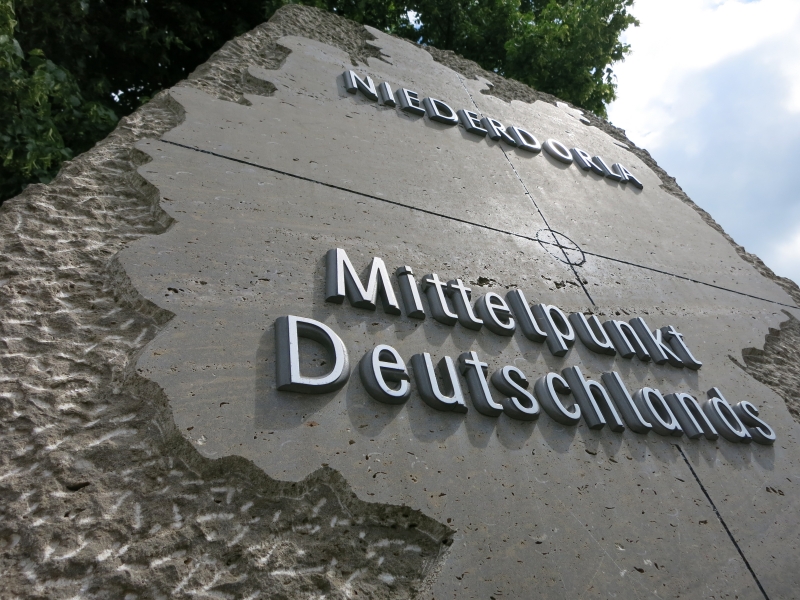
At Pentecost and during the kermis, residents uphold customs passed down from their ancestors. Another prominent landmark lies on the outskirts of the village: the Center of Germany was identified there in October 1990. An imperial lime tree was planted there in February 1991. A festival is held at the Center each year. If you would like to include this festival in your travel plans, check the latest dates in advance.
Relaxation nearby
The Seebach Reservoir near Niederdorla is designated as a fishing lake and local recreation area. It adds a different focus to the area's historic sights. While the half-timbered house, church and village gate are linked to local history, the reservoir is designated for recreation and fishing.
Archaeological history in the Vogtei
Within the wider destination of Vogtei, the Opfermoor Vogtei lies north of Niederdorla. In the exhibition building and on the adjoining open-air grounds, visitors can learn about the lives and beliefs of the ancestors who settled there from the 6th century BC to the 6th century AD. Numerous sanctuaries discovered during excavations spanning several years are on display in the exhibition building; the small Opfermoor museum features original finds from excavations of the settlement and cult site.
Visitors can explore reconstructed houses from a Germanic settlement dating to the 3rd century AD on the grounds. Since 1991, cult sites and parts of a nearby Germanic settlement from the 3rd century have also been reconstructed. These reconstructions are based on excavations by Prof. Behm-Blancke. The Opfermoor therefore focuses on both archaeological finds and reconstructions, while the sights in Niederdorla tell the story of the village itself.
More cultural and cycling route options in the Vogtei
Oberdorla also offers its own points of interest within the Vogtei. The Romanesque St. Peter and Paul collegiate church is worth a visit; its portal features two heavily weathered but impressive depictions of apostles. The Oberdorla local history room explores village life, local and church history, and Vogtland customs. The Unstrut-Werra Cycle Route passes through Oberdorla, a district of the Vogtei. Check the latest route conditions before setting out on a bike ride.
You can tailor your stay to focus on local history, archaeological topics or cycling routes in the Vogtei.
Discover more destinations: Blankenburg, Sundhausen, Obermehler, Weinbergen, Schönstedt, Kutzleben, Südeichsfeld, Schlotheim
For the wider travel overview: Unstrut-Hainich.
