
Discover Wiesloch
Accommodation in Wiesloch
Wiesloch combines traces of different eras with museums and vineyards in the southwest that invite you to go hiking. The city’s history spans Roman and medieval remains, Baroque churches and early automotive history. If you are looking for a hotel in Wiesloch, these themes can help you choose the focus of your stay.
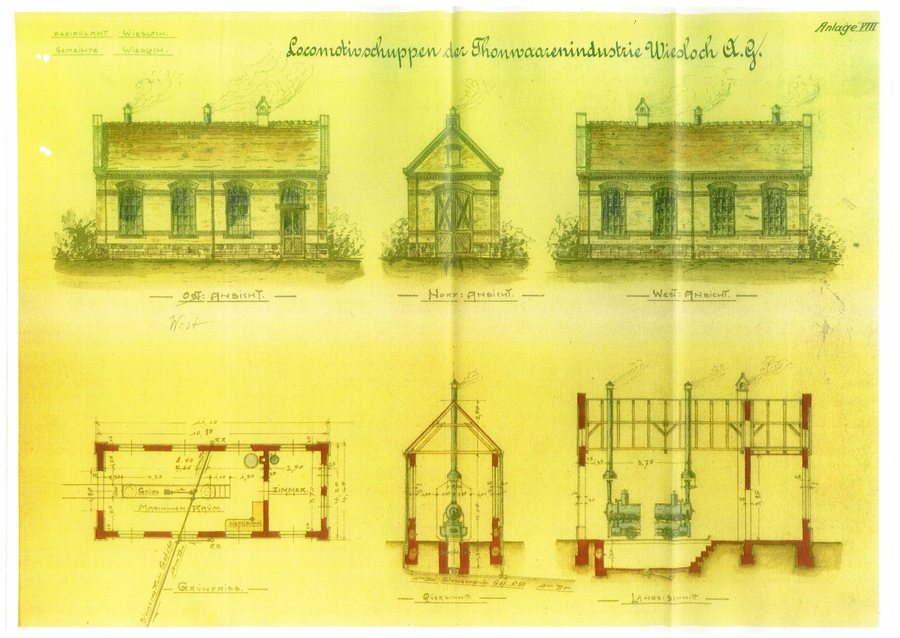 File:1905-lokomotivschuppen-der-thonwaarenindustrie-wiesloch-ag.jpg
Photo: Uncredited and unidentified drafter/contractor to Thonwaaren-Industrie Wiesloch AG via Source, Public domain
File:1905-lokomotivschuppen-der-thonwaarenindustrie-wiesloch-ag.jpg
Photo: Uncredited and unidentified drafter/contractor to Thonwaaren-Industrie Wiesloch AG via Source, Public domain
Buildings from Several Centuries
The Protestant town church was built in the 11th century as a three-aisled Romanesque pillar basilica. Its surviving tower walls are considered to belong to the oldest church tower in northern Baden; a floor window in the nave offers a glimpse of the building’s history. St. Laurentius represents a different era: the church was built between 1745 and 1750 and features lavish Late Baroque furnishings. The high altar was created by Johann Anwander. The contrast between the Romanesque basilica and the Late Baroque furnishings illustrates Wiesloch’s distinct architectural periods.
Secular buildings also preserve traces of the city’s history. The Freihof is the oldest surviving residential building in Wiesloch; its main building belonged to a fortified manor of the von Sickingen family dating from the 14th century. A defensive tower from the 14th century and parts of the palas survive from the former Königsburg. The Sauermillichhaffe defensive tower is part of the medieval city wall; it and the adjoining sections of wall date from the mid-14th century. The Old Town Hall was rebuilt in 1713.
Memorial Sites and City History
Clues in the cityscape mark the locations of former city gates: At the Upper Gate, a plaque and foundations highlighted in color in the pedestrian zone now commemorate the former gate tower. At the Lower Gate, a plaque points to the former entrance to the medieval city, once enclosed by a city wall. Opposite the Dörndl, a well-preserved Roman stone cellar lies in the ditch in front of a section of the medieval city wall. An archway with a keystone dated 1746 marks the former entrance in Wiesloch to the horse-changing station of the princely Thurn and Taxis post.
More recent history includes the journey of Bertha Benz and her sons: On August 5, 1888, Wiesloch pharmacist Ockel supplied her Patent-Motorwagen with about three liters of ligroin as she traveled from Mannheim to Pforzheim. This made Wiesloch’s Stadt-Apotheke known as the “world’s first filling station.” A sculpture of Bertha Benz stands in the Protestant church square. The Karel-Fron-Brunnen fountain is in the market square; it was erected in 1988 to mark the town’s 700th anniversary. A memorial plaque in Synagogengasse commemorates the Jewish community and symbolizes an attempt at reconciliation after the Second World War.
Museums and Special Insights
The Wiesloch Municipal Museum is housed in the medieval Dörndl defensive tower. One of its main themes is mining in Wiesloch, which was carried out from Celtic times through the 1950s. The museum offers individual guided tours on request for kindergartens, school classes and groups. The Museum Stadt-Apotheke focuses on the history of another Wiesloch tradition: it preserves a unique pharmacy interior dating from 1858. Flexible reservations are possible by arrangement; costs depend on the time and effort involved. Confirm the terms when making your inquiry.
The Field Railway and Industrial Museum combines a historic building with a rail journey. Its listed locomotive shed, with smoke hoods for steam locomotives, remains in its original 1905 condition. On event days, visitors can ride the “little museum train” along the reconstructed field railway track through the countryside. Since rides are only available on event days, check the dates before planning your visit.
Vineyards and the Region
The vineyards in southwest Wiesloch invite you to go hiking and enjoy the outdoors. The wider Rhein-Neckar-Kreis destination offers more to explore: Schwetzingen’s Electoral Palace features a Rococo theater and a world-famous park. Ladenburg’s historic center still reflects the Middle Ages and, in part, the Roman era. The annual “Ab in den Wald” program offers free guided forest walks and excursions throughout the Rhein-Neckar-Kreis.
Discover more destinations: Ketsch, Neulußheim, Helmstadt-Bargen, Meckesheim, Weinheim, Hilsbach, Sankt Leon-Rot, Bammental.
Go to the main travel overview: Rhein-Neckar-Kreis.

