
Discover Rövershagen
Accommodation in Rövershagen
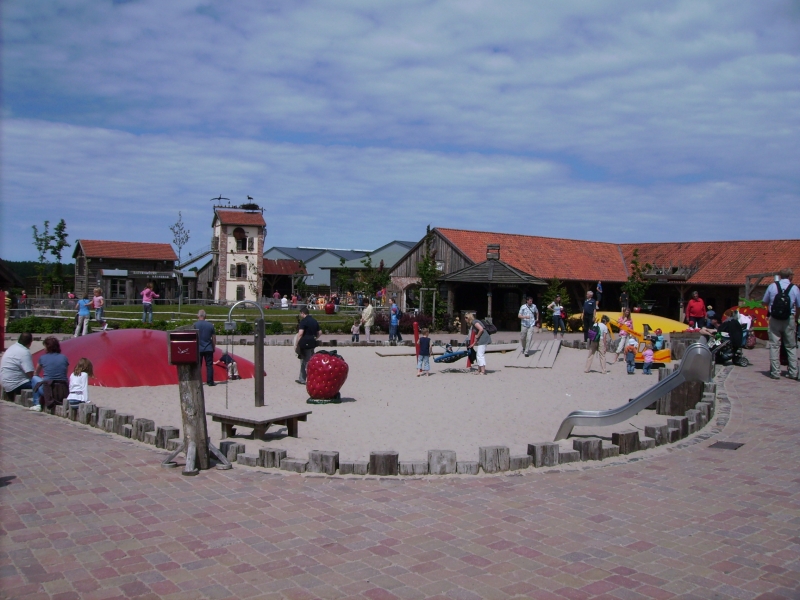
Rövershagen brings together historic buildings and a wide range of things to see and do. The Dutch-style windmill and the late Gothic village church offer a different focus from Karls Erlebnis-Dorf, with more than 50 experiences for visitors. During your stay, you can choose between the history of the mill and the buildings, the attractions at Karls, and practical information about getting to Erlebnis-Dorf.
Windmill and village church: architectural history in Rövershagen
The Rövershagen Dutch-style windmill was built in 1881 as a ground-level Dutch windmill. Its cap is operational and can be turned; the king shaft, milling mechanisms, and bucket elevator have also been preserved. This means you can appreciate the mill not just as a building, but also through specific components of its machinery. The mill is also a popular photo subject and one of the last well-preserved mills of this type in the region.
The village church offers a different architectural accent: it is a late Gothic brick building and is among the oldest village churches in Mecklenburg. If you are interested in architectural styles, Rövershagen offers two distinct examples: a ground-level Dutch windmill and a late Gothic brick church. This brief overview helps you appreciate the two buildings separately, rather than conflating their different functions and forms.
Experiences at Karls
Karls Erlebnis-Dorf Rövershagen offers more than 50 experiences; individual attractions may change. One of them is the narrow-gauge railway. From 10 a.m., it makes loops around the Hüpfparadies (Jumping Paradise) and past the Alles Paletti Hotel for all guests. In the morning, it takes hotel guests to breakfast. These are different uses of the railway; operating details may change. Please check the latest information before your visit.
The Rövershagen Ice World takes place every year across an area of 2,000 square meters. It features ice-sculpture landscapes made from more than 300 tonnes of frozen water. This gives Ice World a different focus from the historic mill: here, the emphasis is on the large-scale seasonal exhibition and its ice sculptures, while the mill showcases its year of construction and preserved machinery. Details of the seasonal exhibition may vary; check the latest information before your visit.
At the Manufakturen-Markt (Manufacturers’ Market) in Erlebnis-Dorf, products are made by hand, including jams, sweets, and chocolate. Visitors can also enjoy fresh coffee. The market offers a tangible insight into how various products are made. The selection may change; if a particular product is important to your plans, check the latest information in advance.
Getting to and finding your way around Erlebnis-Dorf
Only trains on the RB-2 line between Rostock and Graal-Müritz stop at the station by Karls Erlebnis-Dorf. Bus route 118 also stops at “Karls Erlebnis-Dorf.” As timetables are subject to change, we recommend checking connections before you travel. The information about the RB-2 and bus route 118 refers to the stops at Karls.
There is free parking at Karls Erlebnis-Dorf, including free parking for buses. Check the latest parking information before you travel. From the car park and the DB railway and local public transport bus stops at Karls, an approximately 400-meter-long, easy-to-walk or wheel along path leads to the entrance. This distance refers to access to Erlebnis-Dorf. If the condition of the path is important to your plans, check the accessibility information in advance.
For broader travel planning in the Rostock region, buses and trains in Rostock district are part of the transport association. Visitors can travel throughout the region, including the Hanseatic and University City of Rostock, with a single ticket. This regional overview can help you distinguish broader travel options from the specific stops and parking facilities at Erlebnis-Dorf.
Discover more destinations: Bentwisch, Mönchhagen, Blankenhagen, Gelbensande.
Go to the main travel overview: Amt Rostocker Heide.
