
Paspels: History, Castle Trail and Canovasee Lake
Accommodation in Paspels
Archaeological finds from the Neolithic and Roman periods show that the area around Paspels was already inhabited during these eras.
History
Paspels was first mentioned in a document in 1237 as "villa Pascuals". At that time, Alt Sins Castle was the centre of the extensive possessions of the Barons of Vaz in Domleschg. The Chapel of St. Lawrence was also first mentioned in a document in 1237 as the parish church of Paspels. A first chapel on the site of the Chapel of St. Lawrence probably already existed in the 7th century.
Paspels Castle was probably built by Jahn Victor von Travers-Ortenstein around 1695 and extensively remodelled around 1730 by his son of the same name.
Culture
The Chapel of St. Mary Magdalene is a Romanesque single-nave church with a semicircular, very low apse covered with stone slabs. Its interior contains early Gothic murals by the Waltensburg Master dating from the second quarter of the 14th century.
The key to the Chapel of St. Lawrence is kept at the Denner shop in Paspels at Domleschgerstrasse 71. The chapel is about a 20-minute walk from the Paspels, Dorf bus stop.
Castles
Alt Sins Castle, probably built at the end of the 12th century, was originally the seat of a small manor that had developed from the Paspels estate. It was first mentioned in a document in 1285. The ruins of a four-storey residential tower with a curtain wall remain at Alt Sins.
Neu Sins / Canova Castle was probably built by the Lords of Vaz in the second half of the 13th century. Half of the four-storey residential tower remains at Neu Sins / Canova, along with remnants of a fireplace and stove installation and a square cistern built into the bedrock. The Neu Sins / Canova ruins are on private property and are not open to the public, but can be viewed from the Domleschg Castle Trail.
Trails and Water
After passing through a forest and completing a short ascent, the hike from Tomils via Paspels to Scharans reaches the edge of the village of Paspels. A narrow path then leads uphill to the tower of the Alt Sins castle ruins.
The Domleschg Castle Trail can be explored in stages and combined with the PostBus service. Its route includes Canovasee Lake and Paspels, among other places. Alt Sins is located directly on the Domleschg Castle Trail and can be accessed at your own risk.
From the Paspels (Post) bus stop, a path leads along a natural trail to Canovasee Lake and takes about 15 minutes on foot. Canovasee Lake is a warm swimming lake that reaches well above 20 degrees in summer. It is accessible year-round; during the bathing season, a kiosk offers ice cream, drinks, hot dogs, regional grilled sausages, homemade baked goods and various sweets.
Landscape
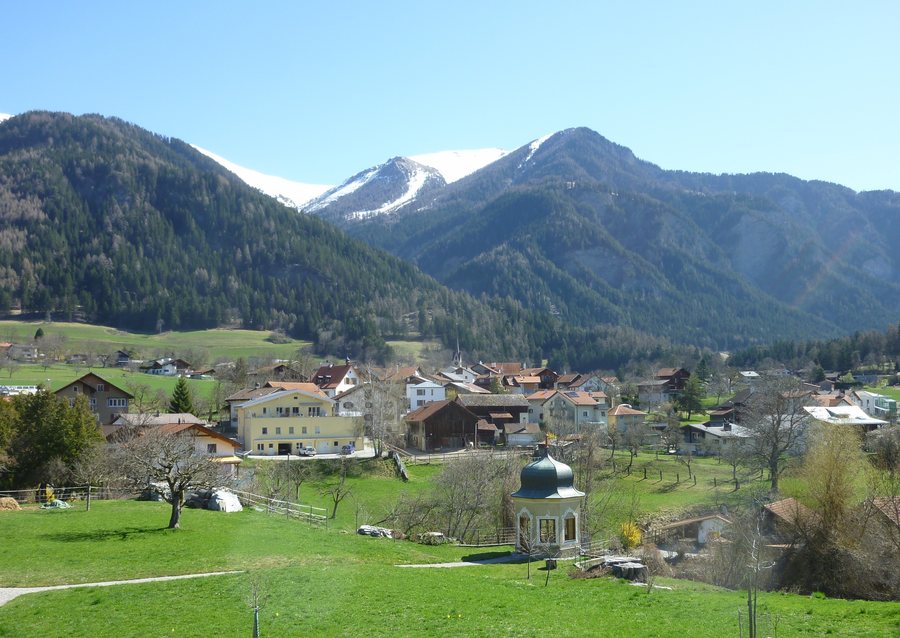
The former municipality of Paspels is located on a terrace above the right bank of the Hinterrhein, on the western slope of the Stätzerhorn. Of the former municipal area’s total 457 hectares, 259 hectares consisted of forest and woodland, 152 hectares were usable for agriculture, 28 hectares were settlement area and 18 hectares were unproductive land, mostly mountainous terrain.
Cattle farming and arable farming predominate in Paspels, along with some fruit growing and viticulture.
More destinations
More destinations: Masein, Ausserferrera, Cazis, Andeer, Almens, Sufers, Avers, Tschappina
To the higher-level travel overview: Hinterrhein.

